Legal AI Document Generation: Benefits and Challenges

Lately, the integration of artificial intelligence (AI) into various sectors has grown exponentially. Legal services are one of the areas that have undergone a transformation. Legal AI, particularly in document generation, has significantly changed how professionals draft legal documents. Through automation and machine learning, it promises to simplify workflows, increase efficiency, and reduce costs.

However, despite its remarkable potential, document generation presents unique challenges. These must be addressed before it can become fully integrated into the legal industry.

Introduction: The Rise of Legal AI in Document Generation

Finger pressing a digital screen with the legal scale, typewiser, legal AILegal professionals have long been familiar with the tedious nature of document drafting. Contracts, pleadings, memorandums, and other legal documents demand precision, consistency, and considerable time. To ease this burden, AI offers automated solutions to manage routine tasks that were once time-consuming and repetitive. Using natural language processing (NLP), machine learning, and advanced algorithms, it can create, review, and amend documents with minimal human intervention.

I/ Benefits of Legal AI Document Generation

A/ Efficiency and Time Savings

One of the most significant advantages of AI in legal document generation is the speed at which tasks can be completed. Traditional document drafting can take hours or even days to finalize, depending on the complexity of the matter. AI-driven platforms, however, can produce accurate and relevant documents in a fraction of the time. These systems are capable of automatically filling in data from templates, reviewing past documents for consistency, and generating draft documents that require minimal human oversight. This efficiency allows legal professionals to focus on higher-level strategic tasks.

B/ Cost Reduction

Legal services are often expensive, largely due to the time and effort required for manual tasks like document drafting. By automating these processes, AI significantly reduces the time spent on low-value tasks, ultimately lowering costs for both clients and firms. For small businesses and individuals seeking affordable legal services, it offers cost-effective solutions without compromising the quality of legal documents.

C/ Improved Accuracy and Consistency

Legal documents require absolute accuracy, as even minor errors can have serious consequences. AI helps minimize human error by using structured templates and algorithms to generate documents that align with legal requirements. However, studies show that legal AI research tools can produce incorrect information in 17% to 33% of cases. While AI enhances efficiency and consistency, it’s essential for legal professionals to review and verify the content to ensure accuracy before finalizing any document.

D/ Accessibility and Scalability

Legal AI solutions make legal document generation accessible to a broader range of people. Legal professionals can benefit from AI-driven tools without having to hire large teams of lawyers. These tools can be scaled to meet the needs of larger firms, helping them manage high volumes of documents with ease. 

For example, Unilever’s legal delivery centers have used AI to process large volumes of legal contracts, increasing productivity and allowing legal teams to focus on more complex tasks.

II/Challenges of Legal AI Document Generation

An open book with futuristic elements in it, Legal AI, Typewiser

While the benefits of AI document generation are clear, the technology also presents several challenges that must be addressed to reach its full potential.

A/ Quality and Interpretation of Legal Language

A major challenge is the complexity of legal language. Legal documents use highly specialized terminology and require a deep understanding of legal principles and the law itself. While AI systems can analyze vast amounts of data, they may struggle to fully grasp nuances, especially ambiguous or context-dependent terms.

B/ Ethical and Accountability Concerns

As AI takes on more responsibilities, ethical concerns around accountability and decision-making emerge. In document generation, a system’s recommendations or outputs could have serious legal consequences. If an AI system generates a flawed contract or an incorrect legal argument, who is responsible? Legal professionals must review and validate AI-generated documents to ensure compliance and accuracy. The question of liability in the event of an AI error remains a significant challenge for the legal industry.

C/ Data Privacy and Security

Legal documents often contain sensitive and confidential information. When using AI tools, law firms and legal professionals must ensure compliance with privacy regulations and implement robust data security measures. If a system is not properly secured, there is a risk of data breaches or unauthorized access to confidential documents. Protecting client data must remain a top priority when adopting AI-driven solutions.

D/ Resistance to Change

The legal industry is deeply rooted in tradition and often cautious about new technologies. Many legal professionals, especially those with years of experience, may hesitate to trust AI for document generation. Concerns about job displacement, reduced quality of legal work, or disruptions to established workflows contribute to this reluctance. Such resistance can slow adoption and prevent the technology from reaching its full potential.

Recent statistics, however, show an increasingly optimistic intake. AI adoption among legal professionals has increased significantly in the past year, with 79% now using AI in their practice, up from just 19% in 2023.

E/ Regulatory and Legal Compliance

Legal documents must adhere to a wide array of regulations and jurisdiction-specific requirements. AI tools must be designed to understand and apply these varying rules effectively. AI systems must be continuously updated to reflect changes in laws, regulations, and legal precedents. Keeping up with the continuously shifting legal framework is a significant challenge for both technology providers and legal professionals.

The Future of AI in Legal Document Generation

Documents, legal scale, futuristic feel, legal AI,  typewiser

Despite these obstacles, AI-driven legal document generation is expected to advance considerably. As technology continues to advance, systems will likely become more capable of understanding legal language and improving the accuracy of generated documents.

Additionally, AI tools will become more user-friendly and integrate seamlessly with other legal technologies, enhancing workflows and collaboration between humans and machines. One such tool is Typewiser, which leverages AI to make legal document drafting faster and more efficient. With a range of templates and automation tools, it helps legal professionals save time while maintaining accuracy. By reducing manual effort, Typewiser allows users to focus on higher-value legal work. Learn more at typewiser.com.


AI Business Models: Opportunities and Challenges in 2025

By 2025, artificial intelligence will have moved well beyond proofs of concept. It will no longer be just a buzzword but deeply embedded within day-to-day business operations, reshaping complex workflows with nuanced, human-like decision-making capabilities. Let’s explore some of the emerging AI models that are currently gaining traction and the exciting opportunities they can unlock.

A screen with Chat AI written, hand typing, purple blue shade, Typewiser, AI business

1. Beyond “AI-as-a-Service” Hype

A lot of businesses are drawn to the “AI-as-a-Service” (AIaaS) trend because it promises quick deployment and lower upfront costs. Much like the shift toward software subscriptions a decade ago, AIaaS is built  to help organizations harness sophisticated machine learning (ML) tools without massive in-house engineering teams or on-premises data centers.

Leveling the Playing Field

Startups and mid-sized companies that might not have the budget to hire a fleet of data scientists can still tap into powerful AI infrastructure. This helps them remain competitive and innovative—even with far larger rivals.

Real-World Caution

While the pay-as-you-go model lowers initial barriers, there’s a risk of over-dependence on one or two service providers. If a company locks itself into a specific platform’s tech stack, switching providers can be disruptive and costly. Early strategic planning is critical: consider how to stay flexible in case needs (or regulations) change, especially in the fast-moving AI business ecosystem.

2. Industry-Specific AI: Going Deep Rather Than Wide

hexagons with multiple images, AI, crane, Typewiser, AI business

One of the clearest lessons from the early AI boom is that context matters. A one-size-fits-all model can be impressive in demos but less useful in specialized environments like healthcare or finance. By 2025, you can expect a surge of vertical AI solutions built on rich, domain-specific datasets.

Practical Use Cases

  • Healthcare: Tools that analyze medical images to detect subtle anomalies, or systems that sift through electronic health records to pinpoint risk factors.
  • Manufacturing: Predictive maintenance that helps factories avoid costly downtime by catching machine failures before they happen.

Niche Expertise

These narrower solutions often come from startups that partner closely with domain experts. The best of them not only develop algorithms but also handle real-world bottlenecks like regulatory approvals and seamless integration with legacy systems.

3. Data Monetization: Treading the Fine Line

As companies gather more data, some see the potential to package and sell it—or offer AI-driven insights—through APIs or marketplaces. This shift can transform data from a passive asset into a dynamic revenue stream, fueling new opportunities in the AI business sector.

Opportunity for Growth

Data, whether it’s on consumer behavior, manufacturing defects, logistics routes, or health patterns, can be incredibly valuable to other organizations that don’t have it. Think of retailers offering anonymized purchasing trend data or smart cities sharing traffic flow data with ride-sharing apps.

Privacy & Ethics

However, there’s a line between responsible data sharing and privacy violations. Stricter regulations (like updated GDPR-style rules or region-specific consumer data laws) will likely surface in the near-future, making compliance a critical aspect of any data monetization strategy. An ethical misstep can lead to legal battles and lasting brand damage.

4. AI-Driven Platforms and Ecosystems

Platforms that incorporate multiple AI capabilities—from natural language processing (NLP) to automated decision-making—are well on their way to becoming the backbone of digital transformation across industries.

Building an Ecosystem

By offering APIs and developer-friendly tools, platform owners can attract a diverse network of startups, enterprise dev teams, and freelancers who build specialized apps on top of the core AI. This fosters network effects—where increased adoption enhances the platform’s capabilities, data richness, and overall value—strengthening its position in the AI business sphere.

Risk of Lock-In

On the flip side, companies that rely too heavily on a single ecosystem may become dependent on that provider’s roadmap, pricing, or even politics. Diversifying technology investments—especially for mission-critical processes—remains a wise approach.

5. Intelligent Automation, Not Just Traditional RPA

Automation written in a box, a man is clicking on the box, Typewiser, AI business

Robotic Process Automation (RPA) initially enabled businesses to automate routine, repetitive tasks. By 2025, RPA has integrated closely with AI, enabling automation of more complex workflows that demand analysis, decision-making, and adaptive responses, going beyond simple form-filling to interpreting data and determining optimal actions.

Workforce Impact

This shift enables workers to focus on creative problem-solving or customer-centric tasks while automation handles routine, rules-based operations. Still, businesses should prepare for upskilling and reskilling: employees need to learn how to interpret AI-driven insights and troubleshoot when things go wrong.

Outcome-Based Business Models

Some AI-automation providers may offer performance-based pricing (for example, fees tied to the cost savings or efficiency gains generated). This aligns vendor incentives with business outcomes but also demands transparent metrics and well-defined expectations.

The Challenges

Regulatory and Compliance Maze

Governments globally are wrestling with how to regulate AI, from setting ethical guidelines to restricting data flows. Soon, expect a patchwork of regulations—some strict, some less so—making it harder for multinational companies to keep track.

Risk Mitigation

Organizations that want to operate internationally need robust compliance infrastructures, from dedicated legal teams to AI-audit protocols that ensure models meet local standards on privacy and fairness. As AI business expands across borders, staying ahead of evolving regulations is crucial.

Hidden Bias and Ethical Dilemmas

One of the persistent problems with AI is that if your data contains bias, your AI will learn it—and propagate it. Addressing these issues requires more than lip service. It involves carefully curating training data, setting up bias detection measures, and planning how to fix issues when they arise.

Human Oversight

Even the best AI model benefits from regular human checks. In sensitive fields like healthcare or criminal justice, a hybrid approach—where AI’s suggestions are reviewed by professionals—helps maintain accountability and trust.

Talent Wars and Skill Gaps

While more universities and training programs are racing to produce AI specialists, the demand often exceeds supply. Businesses of every size are competing for the same talent pool—data scientists, ML engineers, AI ethicists, and more.

Upskilling Matters

Companies that invest in training their existing workforce to work effectively with AI may find it easier to remain competitive than those perpetually trying to outbid competitors for top-tier specialists.

Data Security and High Costs

lock coming out of a computer screen, blue shade, hand holding a pen, Typewiser, AI business

AI can be expensive, especially at scale. Training advanced models often requires specialized hardware like GPU clusters or proprietary chips. Storing, transferring, and protecting large datasets also raises cybersecurity risks.

Measuring ROI

The pressure to justify AI investments is real. Boards of directors and stakeholders want to see tangible returns, not just hype. Managing these expectations, phasing in implementations, and carefully tracking outcomes is crucial for long-term success.

Supercharge Your AI-Driven Business Model with Typewiser

Staying ahead in AI-driven business requires smart solutions. Typewiser, an AI-powered text generator, streamlines the creation of compelling proposals, reports, and content effortlessly. Whether you’re optimizing grant applications or refining business communications, Typewiser puts AI to work for you.

Sign up today and experience smarter writing!


The October 2024 EIC Accelerator: A Record-Breaking Round of Innovation

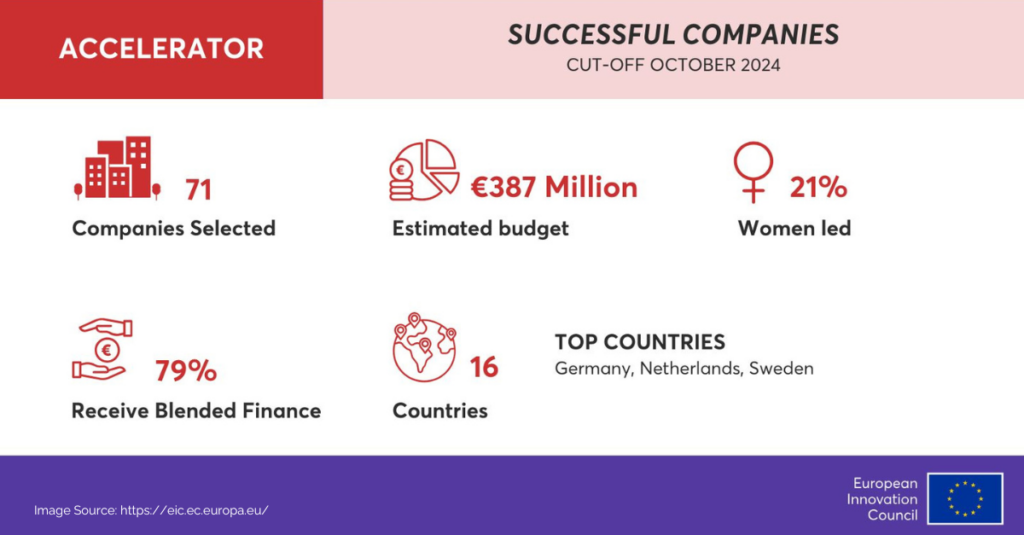
The European Innovation Council (EIC) Accelerator program has once again raised the bar, making its October 2024 funding round the most competitive in history. As of February 2025, 71 game-changing companies have secured a total of €387 million in funding through the EIC Accelerator. The results reflect the program’s growing impact on breakthrough innovation in Europe.

An Unprecedented Level of Competition

With 1,211 proposals submitted, only 6% made the final cut. Out of those, 431 companies advanced to jury interviews before the final selection. 

How Was the Funding Distributed?

Here’s how the €387 million was allocated:

  • Blended finance (grant + equity): 56 companies (79%)
  • Grant-only funding: 10 companies (14%)
  • Equity-only funding: 5 companies (7%)

Blended finance is increasingly becoming the preferred model, ensuring companies receive both immediate capital and long-term investment. 

Did you know some startups get a fast track to EIC Accelerator funding? The ‘Plug In’ scheme allows certified national and regional programs to submit top projects directly to the final application stage—helping innovators secure funding faster.

For the 330 companies that impressed the EIC jury but missed out due to limited funds, the Seal of Excellence opens doors to alternative funding like the Recovery and Resilience Funds and European Regional Development Funds.

Where Are the Winners From?

Innovation is happening all over Europe, but some countries stood out more than others.

The selected companies represent 16 countries, with Germany leading the way (21%), followed by the Netherlands (16%) and Sweden (10%). 21% of the funded startups are led by women (CEO, CSO, or CTO), showcasing a positive shift toward diversity. These results highlight the evolving landscape of innovation supported by the EIC Accelerator.

Which Sectors Are Shaping the Future?

The EIC is betting big on cutting-edge technologies that will redefine industries. Here’s where the money is going:

  • Deep Tech: Quantum computing and advanced semiconductors
  • AI & Data: AI security and synthetic data generation
  • Healthcare & Biotech: Medical devices and gene therapy
  • Energy & Sustainability: Green hydrogen and carbon capture technologies

Meet the Game-Changers: Startups to Watch

Among the winners, a few startups are making waves with their groundbreaking ideas:

  • Brineworks: Extracting CO₂ and hydrogen from oceans in a sustainable way.
  • MOA Biotech: Turning agrifood byproducts into high-value proteins.
  • SICSAI: Developing an Artificial General Intelligence (AGI) model for robotics.
  • CorPower Ocean: Secured up to €17.5 million to advance wave energy technology.
  • BioThrust: Creating bioreactors that revolutionize large-scale cell production.

Which of these innovations excites you the most, and how could they change the world?

Looking Ahead: What’s Next for Innovation?

With such an impressive lineup of startups, the future of European innovation looks bright. As these companies develop their technologies, they could transform industries like clean energy, artificial intelligence, and biotechnology. Backed by the EIC Accelerator, these breakthroughs have the potential to drive significant impact across sectors.

Bridging the Gap: How Can Startups Improve Their Chances of Success?

As funding competition intensifies, how can startups improve their chances of success? One crucial factor is the ability to communicate their vision effectively through compelling grant applications, pitches, and investor proposals. This is where Typewiser comes in—helping innovators craft impactful submissions that resonate with evaluators and investors, especially in programs like the EIC Accelerator.

By offering AI-powered writing assistance tailored for startups and innovators, Typewiser helps craft persuasive, high-impact funding applications that maximize success rates. Whether refining a proposal or structuring a pitch, having the right words can make all the difference. If you’re looking to boost your startup’s chances in the next EIC round, Typewiser could be your secret weapon.

Stay tuned as we follow the journeys of these startups and witness the next big breakthroughs!

The content of this document was created with support from Typewiser.

Is Your Organization Ready to Harness the Power of Generative AI?

Generative AI is no longer just a futuristic concept. It is actively transforming industries by automating workflows, optimizing decision-making, and enhancing content creation. By 2030, AI could contribute up to $15.7 trillion to the global economy, making it a significant driver of future growth. 

However, adopting AI isn’t just about keeping up with trends. Organizations must assess whether they are truly ready to integrate and maximize AI’s potential. AI adoption comes with challenges, including data readiness, workforce training, ethical concerns, and aligning AI with business goals. Here’s what organizations need to consider before implementing generative AI.

Aligning Generative AI with Business Objectives

three tiles, white background, checkmarks at the side, bullseye in the center, generative ai, ai text generator, typewiserJumping into AI without a clear plan can be costly. Estimates suggest that between 70-85% of AI projects fail to meet their objectives. The biggest mistake businesses make is implementing AI just for the sake of it, rather than identifying where AI can drive real value.

AI should be tied to specific outcomes, such as:

  • Automating time-consuming tasks (e.g., report generation, data entry).
  • Enhancing customer engagement (e.g., chatbots, personalized recommendations).
  • Driving better decision-making with real-time data analysis.

For example, AI-powered writing tools help organizations save time on documentation-heavy processes. In grant writing, AI-generated proposals can reduce writing time while improving structure and clarity. However, without a defined goal, AI can create more confusion than efficiency.

Ensuring Data Quality and Compliance

AI is only as good as the data it learns from. Inconsistent, outdated, or biased data can skew AI-generated outputs, leading to inaccurate insights or compliance issues. Data readiness is a key factor in AI adoption.

Organizations must ensure their data is:

  • Accurate – No outdated or duplicate records.
  • Structured – Well-organized for AI processing.
  • Compliant – Meets industry regulations like GDPR and CCPA.

Data compliance is particularly important in finance, healthcare, and government sectors, where AI-driven decisions can impact regulatory obligations. For grant applications, poorly formatted data can lead AI tools to generate inaccurate funding proposals. Ensuring clean, well-labeled datasets is a critical step in making AI truly useful.

Developing an AI-Ready Workforce

small tiles with black outline of people, yellow backgroundai text generator, typewiserAI adoption doesn’t replace employees—it changes how they work. However, 67% of companies report a lack of in-house AI expertise as their biggest barrier to adoption. 

Organizations must build AI literacy across all levels, from executives to operational teams. Key areas include:

  • AI fundamentals – Understanding how AI models function.
  • Data literacy – Ensuring employees can interpret AI-generated insights.
  • Ethical AI use – Recognizing bias, fairness, and compliance risks.

Companies investing in employee training and AI partnerships see greater returns on AI adoption. Hiring AI specialists or providing hands-on AI training programs can help bridge knowledge gaps and accelerate AI implementation.

Implementing Ethical Generative AI Practices

AI decisions impact people, policies, and profits. Without responsible AI governance, businesses risk bias, regulatory fines, and loss of customer trust. 63% of consumers are concerned about potential bias and discrimination in AI decision-making. 

To ensure AI is fair, unbiased, and secure, organizations must:

  • Ensure transparency – AI models should be explainable.
  • Mitigate bias – Diverse training datasets prevent discriminatory patterns.
  • Prioritize security – Protect AI-generated data from cyber risks.

One way to maintain ethical AI use is by implementing “Human-in-the-loop” (HITL) models, where AI suggestions require human validation before final decisions are made. This is particularly useful in industries like healthcare, finance, and hiring, where AI-driven errors can have serious consequences.

Scaling AI in Business Operations

AI should not be viewed as a standalone tool—it must be integrated into existing workflows to maximize impact. Businesses that successfully scale AI follow a structured approach:

  1. Start with a small AI pilot – Test AI in a limited, low-risk environment.
  2. Measure success – Set KPIs (e.g., cost savings, efficiency improvements).
  3. Refine the model – Adjust based on feedback and real-world results.
  4. Scale gradually – Expand AI applications to additional departments.

Organizations that treat AI as a long-term investment rather than a quick fix see the best results in efficiency and decision-making.

Leveraging AI-Powered Tools in Document Writing

ink pern, rainbow splashing colors, ai text generator, typewiserAI is making document creation more efficient by helping organizations generate structured, high-quality content with greater speed and accuracy. Whether drafting reports, research summaries, or technical documents, AI helps streamline the writing process while maintaining clarity and compliance.

Typewiser, an AI-powered writing tool, enhances document creation by helping teams:

  • Build a knowledge library from PDFs, presentations, and notes for AI-driven content alignment.
  • Generate structured, high-quality documents with automated organization and refinement.
  • Edit and refine text instantly, reducing manual writing time and improving consistency.

By integrating AI into document writing, organizations can focus on content strategy rather than formatting and revisions, improving productivity and maintaining high-quality standards.
Explore AI-powered document writing with Typewiser.

Moving Forward with Generative AI

AI isn’t just a tool—it’s a competitive advantage. Organizations that prepare strategically will gain the most from AI’s capabilities. Whether it’s writing reports, conducting research, automating workflows, or crafting grant proposals, AI-powered platforms offer efficiency and structure.

A well-planned approach allows organizations to fully leverage generative AI as a competitive advantage, rather than just a tool, to drive efficiency and innovation.

AI-powered platforms enhance productivity and structure across reports, research, workflows, and grant proposals. Fully harnessing the benefits of generative AI requires investment in AI strategy, high-quality data, skilled teams, and responsible implementation.

Tools like Typewiser, an AI text generator, make it easier to create structured, high-quality content while reducing manual effort. 

With the right approach, AI becomes more than just a technology—it becomes a productivity multiplier.