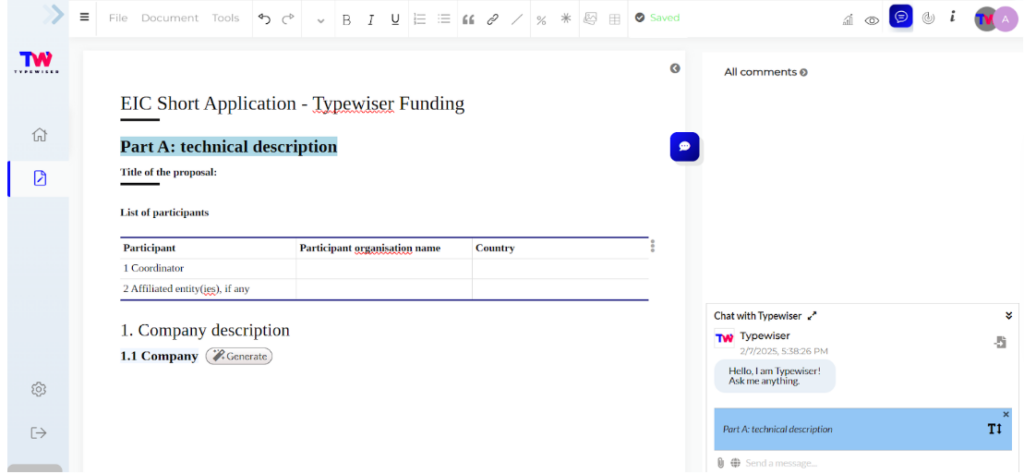
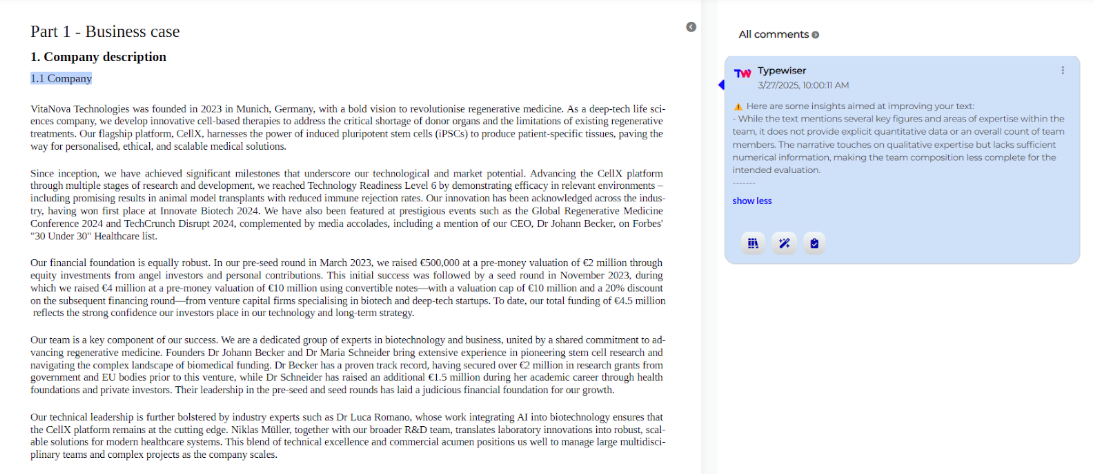
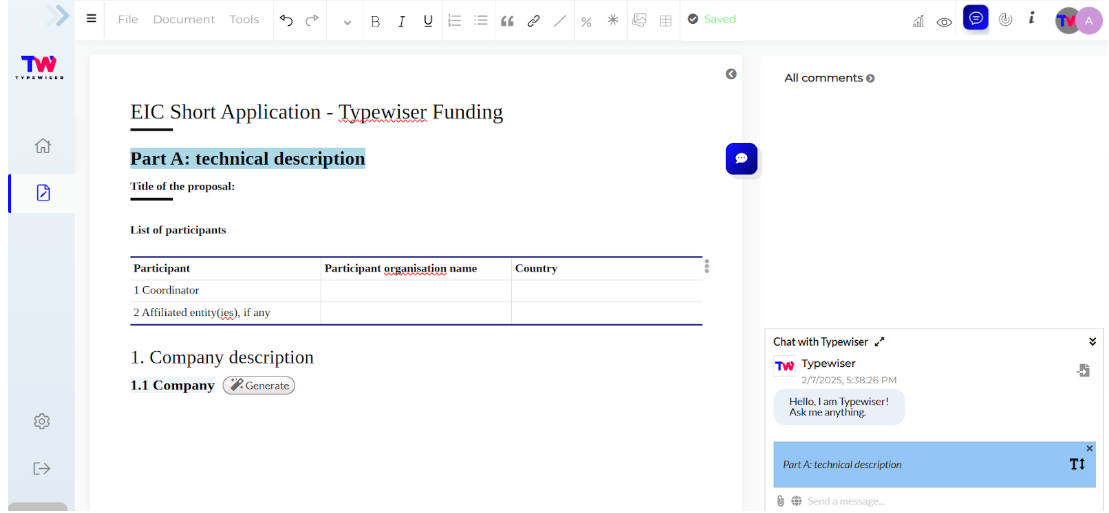
Typewiser Compared to LLMs – Why ChatGPT is Insufficient

Large Language Models (LLMs) like OpenAI’s ChatGPT have become staples for drafting text. However, when writing business-critical documents such as grant proposals, client reports, or detailed project plans, relying on a simple LLM alone can be problematic. These high-stakes documents demand precision, consistency, and domain knowledge that generic AI often lacks. In this article, we compare the capabilities of ChatGPT-style LLMs with Typewiser, a specialised generative AI writing platform. We’ll explore why mainstream LLMs are often insufficient for professional documentation and how Typewiser adds value for teams and organisations.

Limitations of Simple LLMs in Business Writing

While tools like ChatGPT are powerful, users often encounter several issues when applying them to complex workplace documents:

  • Lack of context & domain knowledge: A general LLM used by ChatGPT doesn’t inherently know your specific industry, project details, or the criteria of a grant call. It may produce text that sounds fluent but omits key information or includes irrelevant details unless you painstakingly feed it all the context. The burden is on the user to provide extensive prompts and background for each section, which requires domain expertise and lots of prompt crafting. In short, you often need to guide the AI step-by-step to cover every important point. This frequent frustration ends up undermining any time savings expected through the use of AI, sometimes even setting you back with a negative net time-to-completion on a task. 
  • Accuracy and fact-checking concerns: Mainstream LLMs (ChatGPT) can “hallucinate” – confidently outputting incorrect facts or unsupported claims. In a business document, this is a serious risk; every statistic or assertion needs verification. The AI won’t automatically cite sources or flag dubious content. Ensuring truthfulness becomes the user’s responsibility, meaning extra time spent double-checking and correcting the AI’s output. 
  • Inconsistency in tone and style: When multiple contributors use an AI like ChatGPT, the resulting document can feel patchy – one part might be overly casual, another overly formal. The AI does not enforce a uniform style or terminology. These inconsistencies dilute the message and can harm an organization’s professional image. It often takes significant editing to harmonise tone and wording across sections (essentially negating some of the time saved by generation). 
  • High effort to guide and refine: Getting a well-structured proposal or report out of a generic AI isn’t as simple as typing a one-line prompt. Users typically must break down the task, prompt the AI for each subsection, and then iteratively refine the content. This requires skill in prompt engineering and a lot of oversight. You might also find yourself copying the AI’s output into your document editor, then back to the AI for rewrites – a clunky process. In other words, using a general LLM for complex writing still demands substantial human effort to organise, integrate, and polish the content. 

How Typewiser Fills the Gaps
Typewiser was built to address these shortcomings and streamline the creation of high-quality documents. Here’s how we add value for businesses and teams:

  • Built-in expert guidance: Typewiser plays the senior editor role. As you write, it provides smart guidance and linguistics-driven feedback to keep your document on track. The editor will alert you to missing pieces or vague sections and suggest improvements. For example, it ensures each section has the appropriate level of detail and evidence for your objective, flagging any missing concepts or weak support. This enforcement of best practices (clarity, completeness, relevance) helps ensure nothing important is overlooked and each part of the text is clear and effective. Essentially, the tool makes high-level writing advice available to every user, which is especially helpful for junior writers. 
  • Seamless knowledge integration: Unlike a plain LLM, Typewiser lets you upload your background materials into a private ‘Knowledge Library’. The AI then uses this context to align the generated content with your domain specifics. Need to include data from last quarter’s report or adhere to a specific grant guideline? Typewiser will type in relevant details from your provided sources. This means you spend less time hunting for facts or copying and pasting text for the AI. You get accurate, context-rich content that reflects your proprietary knowledge. The platform also has a built-in web reference search for finding credible sources, helping you back up claims with evidence when needed (something a vanilla LLM won’t do on its own). Even more, the truthfulness analysis it performs as you write flags passages within your text that would benefit from additional support – from scientific papers, market research, to news pieces – and even suggesting specific supporting and contradicting references. 
  • Consistent voice and quality: Typewiser ensures a uniform tone and terminology throughout the document. The AI can be tuned to your organisation’s style guide or past documents, so whether a piece is drafted by a junior analyst or a senior manager, the voice remains consistent. This homogeneity of style and quality builds a stronger brand voice and avoids confusing the reader with jarring shifts. Over time, using Typewiser also upskills team members – by following its suggestions, juniors quickly learn to write with a more polished, professional style. The platform guides users to craft high-performance documents with precision and ease, effectively leveling up the overall writing standard in the organisation. 
  • Efficiency and speed: By consolidating the writing process in one tool, Typewiser greatly accelerates document preparation. It offers an ever-increasing template database and AI-generated outlines to kick-start grant applications. Writers aren’t starting from a blank page, and the AI’s ongoing corrections reduce the number of revision cycles needed. All writing and reviewing can happen in one place, eliminating the back-and-forth between a chatbot, a text editor, and research tabs. In fact, teams have produced complete grant proposals in a matter of days with Typewiser, whereas those projects used to take weeks. Thanks to features like automated consistency checks and content suggestions, you can create polished content in hours instead of weeks. And critically, this speed doesn’t come at the cost of quality – the AI’s guidance makes sure that even a fast-tracked document meets the required standards for accuracy and clarity. 

(Notably, Typewiser’s AI operates by orchestrating multiple specialised language models behind the scenes, rather than relying on a single general model. This multi-model approach helps it deliver superior results in each aspect of writing.)

Real-World Results


One recent example comes from a consulting team preparing an Innovate UK Smart Grant proposal – a complex application that typically takes several weeks of iterative writing. Using Typewiser, the team completed a high-quality draft in just a few days. The platform guided the junior writers through each required section, ensuring they addressed every evaluation criterion and backed up claims with data from the company’s archives. By the time senior consultants reviewed the document, it was already well-structured and cohesive, needing only minor tweaks before submission. Similarly, another team was able to finish an EIC Accelerator short application in a fraction of the usual time. These cases illustrate how a specialised tool can dramatically compress writing timelines without compromising on quality. In fact, the writers were able to work with greater confidence knowing that the AI had systematically checked the content for completeness and clarity at each step.

Conclusion

General-purpose LLMs like ChatGPT have their place – they’re excellent for brainstorming and quick drafts – but they often provide only a partial solution for serious business documentation. The nuances of a big proposal or technical report (ensuring accuracy, completeness, consistent tone, and proper structure) require more oversight and intelligence than a one-size-fits-all AI can offer. Typewiser bridges that gap by combining generative power with domain-specific guidance and an end-to-end writing workflow.

By using Typewiser, organisations can produce documents faster without sacrificing quality, and in many cases even improving it. Junior team members are empowered to create text that reads as if a seasoned professional wrote it, while senior experts can spend more time on strategy and less on line editing. The overall effect is a more efficient workflow and a more uniformly high-quality output across the board. 

“In an era where winning a grant or persuading a client can hinge on the clarity of your documents, having an AI partner like Typewiser is a strategic advantage.”


Case Study: How Real Businesses Are Using AI to Drive Measurable Results

Artificial intelligence (AI) has gone beyond an experimental buzzword. It is delivering tangible value across industries, and recent research shows that companies which fully embrace AI in their operations achieve significantly higher growth and efficiency. For example, organizations with mature AI-driven processes are seeing 2.5× higher revenue growth and over 2× greater productivity than peers. Below, we explore several real-world case studies from the past 2–3 years that demonstrate how AI is boosting operations, customer service, marketing, and product development with clear, measurable outcomes.

Arrow pointing upwards, Typwiser, Case Study, AI

Case Study Transforming Finance: BNY Mellon Streamlines Contracts with AI

BNY Mellon, a global banking leader, faced a major bottleneck in managing complex custodial agreements. Legal teams traditionally drafted contracts manually, which led to version control issues, inconsistent language, and long onboarding times.

To address this, BNY Mellon partnered with Evisort, an AI-powered contract lifecycle management platform. The AI system was trained on the bank’s internal legal guidelines and now automates the creation of “best first drafts” using standard-approved language. Non-compliant clauses are flagged instantly, and digital workflows have replaced outdated email review cycles.

Impact: Contract turnaround time has been dramatically reduced, legal accuracy improved, and onboarding time for clients has shortened. With AI handling repetitive drafting, lawyers can now focus on higher-level tasks, boosting both efficiency and compliance.

Case Study Legal Industry Innovation: Allen & Overy’s AI Legal Assistant

Allen & Overy (A&O), one of the world’s top law firms, manages enormous volumes of documentation across 43 offices. Maintaining consistency in style and quality across global teams was an ongoing challenge until they introduced Harvey, an AI assistant powered by OpenAI’s GPT technology.

Harvey assists with drafting contracts, conducting due diligence, summarizing regulations, and reviewing texts for accuracy and style. Trained on A&O’s templates and legal standards, Harvey helps lawyers quickly generate consistent, high-quality drafts in multiple languages.

Impact: Over 3,500 A&O lawyers used Harvey in a trial to answer 40,000 legal queries. Tasks that used to take hours can now be completed in minutes. AI doesn’t replace human review but significantly reduces the time to create strong first drafts, improving productivity without sacrificing quality.

Boosting Engagement in Marketing: Gumtree’s Smarter Email Copy

Marketing written in big fonts, pencil at the side, animated feel, Typwiser, Case Study, AIClassifieds platform Gumtree, part of the eBay Group, needed to improve engagement in its email marketing campaigns. With 6.5 million users but low open rates, the team struggled to create compelling subject lines that matched their brand voice.

Enter Phrasee, an AI tool that specializes in generating and optimizing marketing language. Phrasee learned Gumtree’s tone and produced multiple subject line variations for A/B testing, all while maintaining brand consistency.

Impact: Gumtree saw a 35 to 50% increase in open rates and a 44% lift in click-throughs. Marketers saved time and delivered better results by letting AI handle the heavy lifting of copy creation and optimization.


Case Study: Amazon – AI-Powered Recommendations Boost Sales

Amazon’s e-commerce success is tightly linked to its AI-driven recommendation engine. The platform analyzes each customer’s browsing and purchase history to suggest products they are likely to buy. These personalized recommendations have a massive financial impact. Up to 35% of Amazon’s sales are generated by its AI recommendation algorithms. In concrete terms, this means that a substantial portion of Amazon’s quarterly revenue (over $143 billion in Q1 2024) can be attributed to AI-curated suggestions. By tailoring the shopping experience to individual preferences, Amazon boosts sales and enhances customer satisfaction and loyalty. This case exemplifies how AI in marketing and product recommendation can translate directly into revenue growth.

Case Study: Telenor – Chatbot Enhances Customer Service and Revenue

Global telecom operator Telenor turned to AI to improve its customer service operations. They introduced an AI chatbot named “Telmi” to handle routine inquiries in multiple languages, providing instant support around the clock. The results were impressive: Telmi improved customer satisfaction by 20% and increased annual revenue by 15% after its rollout. By efficiently resolving common questions and issues, the chatbot reduced workload on human support agents and led to happier customers who were more likely to purchase additional services. Telenor’s experience shows how AI in customer service can simultaneously cut operational costs (through automation) and drive top-line growth. Importantly, the measurable KPIs – higher satisfaction scores and revenue uplift – illustrate a clear return on investment for their AI deployment.

Case Study: Siemens – Predictive Maintenance Prevents Downtime

Manufacturers have been leveraging AI to optimize operations and avoid costly breakdowns. Industrial giant Siemens implemented AI-driven predictive maintenance systems across its production plants. By installing smart IoT sensors on critical machinery and using machine learning to analyze performance data, Siemens can predict equipment failures before they happen. This proactive approach has reduced unexpected power outages by 25%, significantly decreasing production interruptions . In financial terms, avoiding unplanned downtime translated into an estimated $750 million per year in cost savings for the company. These savings come from preventing lost production, scrapped materials, and emergency repair costs. Siemens’ case highlights how AI in operations can bolster efficiency and reliability—measured by fewer outages—and deliver enormous cost savings that directly improve the bottom line.

Case Study: Loft – Generative AI Halves Product Development Time

AI is also accelerating innovation in product development. Loft, a product design firm, integrated generative AI tools into its R&D process to help brainstorm and refine new product ideas. Designers used AI to generate dozens of concept sketches and to analyze customer feedback on prototypes, significantly speeding up the iteration cycle. The outcome was striking: Loft estimates that using generative AI has cut its product development time by 50%. What used to take months of human brainstorming and manual prototyping is now done in a fraction of the time by collaborating with AI. This faster development cycle means Loft can bring new products to market more quickly than competitors, illustrating a clear competitive advantage. Moreover, the AI-assisted process often yields more diverse and creative ideas (since the AI can suggest “outside-the-box” concepts), leading to innovative features that resonate with customers. The key metric – development time reduced by half – showcases AI’s value in boosting productivity and agility in product design.

Key Takeaways: AI is Driving Real Business Value

These real-world examples highlight a shared truth: AI is not theoretical anymore. It’s a practical enabler of growth, efficiency, and innovation. Across industries and functions, AI is:

  • Accelerating processes (e.g., drafting contracts, product development)

  • Enhancing customer engagement (e.g., personalized recommendations, optimized copy)

  • Reducing costs and errors (e.g., predictive maintenance, legal compliance)

  • Improving decision-making with data-driven insights

For business leaders, the message is clear: strategic investment in AI is a competitive necessity. Companies that adopt AI thoughtfully are achieving faster time to value, improved customer experiences, and measurable performance gains.

If you’re not already exploring AI, now is the time to start—before your competitors leave you behind.

Why 80% of AI Projects Fail – And What You Can Do Differently

Artificial intelligence (AI) promises transformational efficiency and insights for businesses. Yet behind the success stories, there’s a sobering statistic: by some estimates, over 80% of AI projects fail. Many companies enthusiastically launch AI pilots only to see them fizzle out or get abandoned.

AI written on a brain, AI projects, Typewsier, AI

In fact, one study found 88% of AI proofs-of-concept never reach production – for every 33 AI pilots, only 4 make it to wide deployment. What happens to the rest? Too often, they stall and eventually teams quietly revert to manual processes after the initial rollout. The excitement fades, support tickets spike with confusion, and employees fall back to familiar ways of working.

Why do some organizations successfully weave AI into their operations, while others retreat to the old ways? The answer goes far beyond algorithms and tech talent. It lies in the less glamorous side of innovation: communication, documentation, and internal knowledge sharing. This blog post dives into those human and organizational factors – the often overlooked reasons some businesses thrive with AI and others fail. 

The AI Adoption Paradox: Hype vs. Reality

Businesses big and small feel the pressure to “get into AI.” We’ve hit a point where AI adoption is mandatory, but understanding it is optional. Executives pour budgets into AI projects – yet results are not optional. The paradox is stark: leaders believe AI is critical, but relatively few organizations are truly ready to integrate AI into how they work. Surveys show a huge gap between aspiration and reality. One RAND Corporation report noted more than 80% of AI projects fail, a failure rate twice that of other IT projects. Gartner likewise predicts a large chunk of experimental AI initiatives will be abandoned after proof-of-concept.

What’s going wrong? It turns out the technology is often not the culprit – the organization is. A 2025 analysis summed it up well: “Most AI pilots fail to scale – not because the tech doesn’t work, but because the foundation isn’t ready.” The biggest issues are “misaligned goals, weak data infrastructure, unclear ownership, and lack of cross-functional support,” which keep companies stuck perpetually in pilot mode. In other words, you can have brilliant data scientists and cutting-edge algorithms, but if your business hasn’t done the homework on communication, processes, and data readiness, AI will stall.

To understand this better, let’s peel back some key failure factors that keep coming up across industries. You’ll notice a pattern: these are fundamentally human and process problems rather than technical limitations. The encouraging flip side is that companies who address these areas – communication, documentation, knowledge sharing, data quality, ownership – are the ones turning AI from buzzword to business value.

Communication Breakdowns: The Silent Killer of AI Projects

Laptop with desings coming out, AI projects, Typewsier, AI

Every successful AI initiative needs a clear purpose and alignment. And that requires communication – between leadership and engineers, between data teams and business units, and with end-users. Unfortunately, many failed projects suffer from a communication breakdown at the start. If stakeholders misunderstand or miscommunicate what problem needs to be solved using AI, the project is doomed from day one.

Commonly, leadership greenlights an AI project to “do something with AI” without articulating a concrete business need. Meanwhile, technical teams might build something cool but misaligned with what the business actually needs. One industry survey found misalignment with organizational priorities to be a top reason pilots never progress. Lack of clear objectives was explicitly cited as a killer of AI proofs-of-concept. If nobody communicates a north-star goal or measurable KPI for the AI, how will anyone know if it’s working? If you don’t know where you’re going, any road will take you there – and probably into a ditch.

Poor communication also plagues the execution phase. Consider the gap between technical and non-technical teams. In thriving AI adopters, business domain experts and AI developers talk to each other frequently, ensuring the model’s outputs make sense in context. In failing cases, these groups operate in silos. The result: AI solutions that users find irrelevant or confusing. 

The Society for Human Resource Management (SHRM) observed that many technical issues blamed on “data” are actually organizational – “data silos, poor documentation, and misuse often result from teams not working together effectively to understand both the domain and the data itself.”. In essence, the data scientists, engineers, and business folks weren’t on the same page. Without a shared understanding, the AI might solve the wrong problem or present insights in a way that front-line employees don’t trust.

Communication from AI teams to leadership matters as well. Leaders may have unrealistic expectations (we’ve all heard execs ask why an AI can’t just magically do XYZ). If technical teams don’t effectively educate leaders on AI’s limitations and probabilistic nature, overhyped goals can lead to disappointment. Conversely, if engineers fail to communicate the infrastructure or data investments needed, executives might underfund critical foundations. In short, AI projects live or die by communication: setting realistic goals, aligning on what success looks like, and keeping all stakeholders in the loop.

Real-world example: One Fortune 500 retailer launched an AI demand forecasting tool built by a specialist team. It technically worked, but regional managers ignored its recommendations – they’d never been included in discussions about how to use it. Lacking context or training, they distrusted the “black box” forecasts and stuck to their manual spreadsheet predictions. The AI was quietly shelved. This kind of story is all too common: fancy pilot, poor communication, zero adoption. Contrast that with companies like Netflix, where an experiment-driven culture means test results and insights are openly shared across the company. Netflix employees at all levels develop intuition about the data because leaders “openly and candidly sharing test results allows everyone…to develop intuition” and learn from each experiment. That kind of communication and knowledge transparency drives engagement with AI initiatives instead of resistance.

The Documentation & Knowledge Sharing Dilemma

Holograms of documents, AI projects, Typewsier, AI, Hand writing on document

When businesses thrive with AI, it’s often because they treat knowledge as a first-class asset. They document processes, create data dictionaries, maintain updated FAQs – they have a culture of turning tacit knowledge into accessible documentation. Why does this matter so much for AI? For one, machine learning models and AI tools often rely on existing data and content. If your data is messy or your content (like policies, manuals, records) is outdated or inconsistent, AI models will reflect those flaws. “Garbage in, garbage out” is the brutal truth.

Moreover, documentation is key for the humans who must use and trust the AI. If an AI system makes a recommendation and no one understands where it came from or how to interpret it, people won’t use it. Consider an AI customer support assistant suggesting responses to agents. If there’s no internal knowledge base explaining the rationale or source of those suggestions, agents will hesitate to trust them. On the other hand, if the suggestion links to a well-maintained internal wiki page or SOP document, the agent gains confidence. Clean, accessible documentation provides context that bridges AI output with human decision-making. It’s like giving your team a map to navigate the AI’s recommendations, instead of leaving them guessing.

Lack of documentation also hurts continuity. AI projects are not “set and forget” – they require ongoing tuning, retraining, and integration with business changes. If the original team leaves and there’s no documentation of how the model was built, what data it needs, who to contact for data issues, etc., the project can wither. Unfortunately, many companies have learned this the hard way: they build a pilot with outside experts or a small innovation team, but when it’s time to hand off to an operational team, nobody has the documented knowledge or ownership to carry it forward.

Knowledge sharing needs to be dynamic as well. Static documents no one reads won’t help. The companies succeeding with AI tend to have vibrant internal knowledge networks – think live documentation, wikis, Slack/Teams channels for Q&A, regular teach-ins or demos. Startups often underestimate how vital this is. In contrast, a company like Amazon has a famed writing culture (requiring six-page narratives for proposals) which forces clarity. Every major initiative is accompanied by detailed documentation that anyone in the organization can reference. That level of clarity and record-keeping pays dividends when implementing complex tech like AI, because teams aren’t operating on unwritten assumptions. The moral: documentation isn’t a bureaucratic chore; it’s the scaffolding that supports AI success.

Data Readiness: The Unsung Hero

We often hear that “data is the new oil.” If that’s true, many companies’ oil is unrefined – full of impurities, locked in barrels no one can open, or scattered in unknown locations. Lack of data readiness is a deal-breaker for AI adoption. In the rush to implement AI, organizations sometimes skip the grunt work of cleaning and organizing data, only to watch the AI project crash and burn. 

Data readiness means more than having a lot of data. It means the data is high quality, accessible, integrated, and relevant for the AI task. Companies that thrive with AI typically have strong data governance and engineering practices in place beforehand: well-defined data pipelines, unified data warehouses or lakes, and clarity on data definitions. Those that fail often discover too late that their data is in disarray – perhaps living in siloed legacy systems, full of duplicates or errors, or missing crucial elements. A survey of Chief Data Officers found 68% blamed poor data quality for AI project failures. Similarly, 28% of enterprise data is actually connected on average, meaning 72% remains siloed or unreachable for analysis. That’s a sobering figure: if most of your information is fragmented, any AI you deploy is drawing from a very incomplete well of knowledge.

We can look at an illustrative failure: IBM’s much-publicized Watson for Oncology project. Here was a cutting-edge AI meant to revolutionize cancer treatment recommendations. But at MD Anderson Cancer Center, the project collapsed spectacularly. After 4 years and $62 million spent, MD Anderson pulled the plug without ever deploying Watson on real patients. Why? One big reason: the AI couldn’t tap into the hospital’s data. The medical records system had changed, and Watson “was unable to tap patients’ data, decipher doctors’ notes and patient histories.” The necessary data integration and cleaning just wasn’t there. In effect, the smartest AI in the world was rendered useless by lack of access to the right information. Doctors reverted to their traditional methods, and the grand AI initiative was written off as a failure and quietly abandoned. This story is extreme but instructive: if your data isn’t ready and reliable, your AI will be a very expensive experiment that goes nowhere.

On the other hand, businesses that prepared their data infrastructure often see AI success almost as a byproduct. Walmart, for example, invested for years in integrating its supply chain data, point-of-sale data, and vendor data. So when Walmart applied AI for predictive analytics in inventory and logistics, the models had a goldmine of consistent data to draw from. The results were powerful: fewer stockouts, optimized routing, and millions in savings. The takeaway is clear – getting your data house in order is perhaps the unglamorous, yet most critical, step in AI adoption. It’s the part that doesn’t make headlines, but it decides whether your AI pilot thrives or faceplants.

Ownership and Collaboration: Who Drives the AI Bus?

Even when communication is flowing and data is ready, there’s another organizational pitfall: unclear ownership. AI projects that thrive usually have a clearly designated owner or team responsible for driving the project to value. Those that flounder often suffer from the “everybody and nobody in charge” syndrome. For instance, a company might assume that the IT department will handle the AI model, the business unit will handle implementation, and the data team will handle data prep – but without a single throat to choke (or champion to credit), coordination falters. If no one is accountable for the outcome, then critical tasks fall through the cracks: who ensures the model is updated with new data? Who trains the end-users? Who measures ROI and iterates on the solution? Ambiguity here is deadly. 

Cross-functional collaboration ties into ownership as well. AI projects, by nature, span tech and business domains. If departments guard their turf or “toss the project over the wall” to another, the effort disintegrates. Conversely, when AI efforts include all stakeholders from day one – IT, business, compliance, end-users – the chances of success skyrocket. A 2025 Microsoft AI adoption study found that 100% of organizations at the advanced stage of AI adoption had leadership that clearly communicated AI’s importance and fostered collaboration. In short, everyone knew who was driving the AI initiative and why, which aligns the entire organization.

Conclusion: Knowledge and Clarity Fuel AI Success

At first glance, AI adoption might seem all about cutting-edge algorithms, fancy tools, and hiring PhD-level talent. But the tales of triumph and failure we’ve explored tell a different story. The root causes of sustainable AI success (or failure) are often mundane and very human: how well teams communicate, how diligently knowledge is documented and shared, how prepared and accessible the data is, and how clearly responsibilities are defined.

When a business thrives with AI, it usually has mature practices in these areas. Communication is frequent and jargon-free, bridging the gap between techies and business folks. Documentation is treated as a living asset – from data catalogs to process docs – so that both people and AI systems can tap the organization’s knowledge. There is a culture of learning, where lessons (and even failures) from AI experiments are shared widely, not kept in silos. Data isn’t an afterthought, it’s proactively cleaned and integrated, allowing AI to actually perform as advertised. And importantly, everyone knows who owns the AI initiative and how it aligns to strategy.

On the flip side, when AI projects  fail and the company sheepishly goes back to manual processes, it’s often due to a failure in one of these fundamentals. Maybe the project had plenty of technical talent, but no one talked to the end-users (poor communication) or the training data was scattered across five legacy systems (poor data readiness). Or the AI worked fine, but employees didn’t trust it because they had no context for its outputs (poor knowledge sharing and documentation). Or perhaps it never moved beyond pilot because once the demo was done, no department wanted to take ownership of implementation (unclear ownership). These “people and process” issues can quietly undercut even the most promising technology.

The encouraging takeaway for startup founders and researchers is this: the key to AI success is in your hands, not just in the hands of some genius coder or expensive platform. Promoting a culture of clear communication and strong documentation is an investment that will pay off in any tech adoption, doubly so for AI projetcs. Think of it like preparing the soil before planting a garden – you need to pull the weeds of siloed information, enrich the ground with documented knowledge, and ensure everyone knows what seeds we’re planting and who’s watering them. With such a groundwork, AI initiatives have a truly real chance to grow and bear fruit.

Corporate AI adoption is as much a management and culture challenge as it is a technical one. Businesses that recognize this – that treat internal communication, documentation, and knowledge structure as strategic priorities – are the ones turning AI projects from a buzzword into tangible impact. They thrive because they’ve built the internal muscle to support advanced technology. Those that neglect these fundamentals may get a flashy pilot going, but they’ll likely see it sputter out and find themselves back at square one. The message is clear: If you want AI to succeed in the long run, invest as much in your organization’s knowledge infrastructure as you do in the technology itself. AI can be a game-changer, but only if the humans behind it are aligned, informed, and empowered. And that comes from a foundation of great communication and great documentation – the unsung heroes of long-term AI success.

How AI and Open Science Are Making Research Accessible Worldwide

For decades, barriers like paywalled journals, language gaps, and isolated data have kept much of science out of reach for many.

Coding, blue background, Typewiser, AI and Open Science, However, more recently, a powerful combination of AI and open science is breaking down these walls. Open science champions the idea that knowledge should be freely shared and inclusive, making scientific research “accessible to everyone” and the process of knowledge creation “inclusive, equitable and sustainable”.

In this blog post, we’ll explore how AI and open science together are opening up research to the world. 

Global Collaboration Through AI and Open Science

One of the core ideas of open science is that sharing and collaboration make research better. 

Instead of guarding data or working in isolation, scientists around the world are increasingly pooling their knowledge to tackle big challenges. 

Open science “increases scientific collaborations and sharing of information for the benefit of science and society”​. An important aspect of this openness is transparency – making methods, data, and results visible so that others can learn from them, verify them, or build on them.

A great example of global collaboration in action is the CERN Open Data Portal. CERN, home of the Large Hadron Collider in Switzerland, generates enormous amounts of particle physics data. In the past, such data might only be analyzed by an elite team on site. But CERN’s open data platform now makes these datasets freely available to researchers anywhere with an internet connection​.

In fact, the CERN Open Data portal explicitly aims to share data with “researchers outside the CERN experimental teams, as well as citizen scientists,” and provides curated resources for education and training​. 

This means a physics student in Brazil or a data enthusiast in Kenya can download actual LHC experiment data and try their hand at analysis. Already, there have been scientific papers published based on this openly shared data​.

Open data platforms like this foster global collaboration – someone who could never build a particle collider can still participate in particle physics research, bringing diverse perspectives and talents into the fold.

Citizen science projects exemplify this by inviting people from all walks of life to contribute to real research. Consider Zooniverse, the world’s largest platform for citizen science. Founded in 2007, Zooniverse has connected research teams with more than 2.7 million volunteer “citizen scientists” around the globe​.

Through Zooniverse, volunteers help classify galaxies, count penguins in images from the Antarctic, transcribe historical documents, and more – tasks that are “too tricky for computers to parse and too big for any research team to tackle on its own”​. 

By encouraging collaboration across borders and even outside academia, open science is creating a richer, more diverse research ecosystem. A global team can attack problems from multiple angles and consider a wider range of needs. 

For example, sharing data on diseases or climate change openly allows researchers in countries most affected by these issues to contribute insights and solutions, rather than waiting for information to trickle out. 

This kind of inclusive collaboration was crucial during the COVID-19 pandemic, when scientists worldwide shared genomic data and research findings freely in real-time, and used tools (often AI-driven) to analyze a flood of papers. It’s a powerful reminder that knowledge grows faster and stronger when everyone shares what they know.

AI Breaking Barriers: From Language to Information Overload — 2025 update

A laptop with alot of pages in between, gray color, Typewiser, AI and Open Science, Opening up all this science is wonderful — but it also creates a new challenge: information overload. With millions of research papers and huge datasets now accessible, how can any one person find the knowledge they need or make sense of it all? 

This is where AI steps in as a crucial partner to open science. State-of-the-art language models are becoming the research assistants we desperately need, helping us search, translate and summarise scientific information at super-human scale and speed.

GPT-class models are rewriting the rules of scientific translation

Until recently, neural machine translation (NMT) tools such as Google Translate and DeepL dominated the field, but the latest generation of GPT models has up-ended the landscape.

  • Real-time, multimodal translation. Among the demo use-cases showcased at launch was live voice-to-voice translation between multiple languages, powered by the new low-latency Realtime API.
  • Quality that rivals (and sometimes beats) legacy MT systems. 
    • A March 2025 evaluation across three Indian low-resource languages (Sanskrit, Telugu and Hindi) found GPT-4o consistently outperformed Google Translate on semantic-similarity and sentiment-preservation metrics, delivering translations closer to expert human versions.

  • Translation as part of the research workflow. Because GPT models are multimodal, a scientist can now drop a PDF, a slide deck or even a lab-notebook photo into ChatGPT and receive an instant draft translation, glossary look-ups and a plain-language summary. Journals and pre-print servers have begun to experiment with GPT-powered pipelines that publish parallel translations alongside the original manuscript, broadening readership without adding delay or staff overhead. 
  • What still needs work. Despite these leaps, GPT systems are not flawless. Peer-review studies highlight that figurative language, domain-specific jargon and very low-resource language pairs remain stumbling blocks, and models occasionally slip into code-switching or overly literal phrasings. Ethical guidelines therefore urge authors to double-check AI translations for accuracy and cultural sensitivity, and to disclose AI assistance in manuscripts.

Beyond language: taming the fire-hose of open data

Translation is only half the battle; once papers are readable, researchers must still find and digest the right knowledge. AI tools purpose-built for science address this “needle-in-a-haystack” problem:

  • Semantic Scholar now offers GPT-based one-sentence abstracts and citation-graphs for more than 200 million papers, letting users scan a topic in minutes. 
  • Elicit automates literature searches and evidence tables, extracting sample sizes, outcomes and confidence intervals with a single query.

In short, the latest GPT models have shifted machine translation from “good enough for a gist” to “good enough to cite.” As real-time, multimodal translators become commonplace, the language barrier that once siloed scientific knowledge is fading fast, bringing the vision of truly borderless, open science within reach.

The Role of Policy and Ethics in AI and Open Science

Typewriter with a paper that says AI ETHRICS, Typewiser, AI and Open Science, Technology and community efforts are driving a revolution in how science is done, but lasting change also requires the right policies and ethical guidelines. 

Open science thrives when institutions and governments actively support it through policy. 

For instance, many funding agencies and journals now mandate open access publishing – meaning that scientific papers must be made freely available to the public, not locked behind subscription fees. 

Major research funders in Europe launched Plan S, an initiative requiring that any research they fund be published in open access journals or platforms. Similarly, in the United States, the White House’s science office issued guidance that federally funded research papers should be made openly available without delay. These policies remove legal and financial barriers, ensuring that a student or scientist anywhere in the world can read the latest findings without restriction. 

Open data policies are also emerging, requiring that data from research (especially publicly funded research) be shared in repositories like Zenodo or Dryad for others to reuse. By building openness into the rules of research, policy can cement the gains of open science and make them the new normal.

Ethics is the other side of the coin – it’s about doing openness right. As we use AI and open up science, we must be mindful of issues like privacy, consent, and fairness. For example, medical research data needs to be shared in ways that protect patient identities. Traditional knowledge from indigenous communities should not be openly shared without permission, to avoid exploitation. AI tools need to be used responsibly, with awareness of potential biases in algorithms. 

There is active discussion in the scientific community about responsible AI in research – for instance, ensuring that AI models used to analyze data are transparent (so their results can be understood and verified) and that they don’t inadvertently disadvantage researchers from regions with less data. 

The UNESCO Recommendation on Open Science (adopted in 2021) underscores the importance of a “fair and equitable open science for all”, calling on countries to create enabling environments and infrastructure for open science while addressing technological and knowledge divides​. It emphasizes that open science should reduce gaps between and within countries, not widen them – a principle that guides ethical sharing of knowledge and tools.

International frameworks like the UNESCO recommendation also highlight values such as inclusivity and accountability in science. By making openness a matter of principle, they ensure that as we embrace openness, we also respect diversity and equity. This includes promoting multilingual science (so that English isn’t a gatekeeper – tying back to AI translation efforts) and involving a broad range of stakeholders in science (from big universities to community labs). 

It also involves training and capacity-building: not every researcher has the same resources to adopt open practices or AI tools, so initiatives that teach data science or provide computational resources to under-resourced groups are vital. Ethical open science means providing everyone the opportunity to participate and benefit, thereby truly making research a global public good.

A More Open and Intelligent Future

AI and open science are reshaping research into a more inclusive, accessible, and collaborative effort. From labs in Tokyo to classrooms in Manila, knowledge is being shared globally, enabling anyone with curiosity and the right tools to contribute. AI is helping break down barriers—linguistic, geographic, and disciplinary—bringing science closer to communities everywhere.

Challenges remain, from paywalled research to uneven digital access, and the ethical use of AI must stay a priority. But the shift toward openness is clear. With growing global collaboration, better tools, and a new generation demanding transparency, the vision of borderless, democratic science is fast becoming reality.

​Corporate AI Adoption: Why Some Businesses Thrive and Others Fail​

Corporate AI has become a powerful force for change, offering businesses the ability to rethink their operations and customer engagement.

 Success in corporate AI adoption often comes down to a company’s ability to align AI initiatives with business objectives and integrate the technology effectively, whereas many face challenges such as inadequate planning or lack of technical expertise. 

The disparity often comes down to how AI is approached: whether it’s seen as a strategic asset or just another tool. For organizations to succeed in leveraging AI, it requires more than just adopting the technology — it demands clear vision, execution, and the right mindset. 

But what exactly makes the difference between those who thrive with AI and those who fall short?

The Promise of Corporate AI in Business

The capabilities of corporate AI are vast, transforming the way businesses operate in nearly every sector. Here are a few key areas where AI is making waves:

  • Operational Efficiency: Automating repetitive tasks using corporate AI can significantly reduce costs and improve operational efficiency. A recent report from Google found that UK workers could save an average of 122 hours per year through AI-powered automation of administrative tasks. This is an example of how corporate AI can free up human resources for more strategic and creative work
  • Enhanced Customer Insights: By leveraging corporate AI, businesses can analyze vast amounts of customer data to generate actionable insights. Companies like Fiserv have incorporated AI-powered conversational surveys to gather valuable customer feedback, leading to improved customer satisfaction and increased revenue. The power of AI in personalizing customer experiences can be a major differentiator in today’s market.
  • Strategic Decision-Making: Corporate AI can support data-driven decision-making by providing in-depth analytics on various factors like market trends, consumer behavior, and operational performance. This enables organizations to make better-informed decisions, resulting in faster growth and a stronger market position. Although some companies harness AI to drive innovation and efficiency, others struggle to unlock its full potential.

Common Pitfalls 

The gap between success and failure in corporate AI adoption is often due to a few key pitfalls that organizations face. Without careful consideration, companies can miss the mark when implementing AI technologies.

  1. Lack of Clear Objectives: One of the most common reasons corporate AI adoption fails is the absence of clear, measurable goals. When businesses implement AI without understanding the specific problems they want to solve, it’s easy for the initiative to lose direction. Organizations should focus on addressing specific challenges or goals, such as improving customer service or reducing costs, rather than just adopting AI for the sake of it. Defining success at the outset is crucial for long-term results.
  2. Poor Data Quality: Data is the backbone of corporate AI. AI systems are only as good as the data they are trained on. Inaccurate, incomplete, or biased data can lead to incorrect predictions and decisions. To maximize the effectiveness of corporate AI, businesses must invest in data governance strategies that ensure data accuracy, completeness, and fairness. Poor data quality is one of the leading causes of AI failures, and businesses must prioritize it for AI projects to succeed.
  3. Inadequate Infrastructure: Adopting corporate AI requires significant computational power and scalable infrastructure. Without the right technological foundation, businesses risk facing bottlenecks that hinder AI performance. Companies must ensure they have the necessary hardware, cloud solutions, and platforms that can handle AI workloads. Whether it’s on-premises or cloud-based, ensuring that your infrastructure is scalable and flexible is critical for supporting AI initiatives.
  4. Talent Shortage: AI adoption requires a skilled workforce with expertise in data science, machine learning, and AI development. Unfortunately, there is a talent shortage in the AI field, and many companies struggle to find qualified professionals. Whether through hiring AI experts or upskilling existing staff, businesses must invest in talent development to successfully implement corporate AI. Without the right expertise, even the best AI tools will struggle to deliver their full potential.
  5. Cultural Resistance: Change is difficult, and employees may resist the implementation of corporate AI due to fears of job displacement or simply unfamiliarity with the technology. Overcoming this resistance requires a cultural shift that embraces innovation. It’s essential for businesses to communicate the benefits of corporate AI, such as reducing the burden of repetitive tasks and creating new opportunities for more meaningful work. By fostering an adaptive and open mindset, organizations can ease the transition to AI adoption.

Strategies for Successful Corporate AI Integration

To overcome the challenges of corporate AI adoption and achieve success, organizations need a clear, structured approach. Here are some strategies to ensure a smooth and effective AI integration:

  • Define Clear Objectives: Start by identifying the specific problems that AI will solve. Establish measurable goals that align with the organization’s broader strategic vision. Whether it’s improving operational efficiency or enhancing customer satisfaction, having a clear objective is essential for success.
  • Invest in Data Management: High-quality data is key to successful corporate AI implementation. Implement strong data governance protocols to ensure data integrity, accessibility, and relevance. Proper data management will ensure that the AI systems function as intended and provide accurate insights.
  • Build the Right Infrastructure: Ensure your infrastructure can scale with the demands of corporate AI. Invest in cloud-based solutions or on-premise hardware that is flexible and capable of handling AI workloads. Scalable infrastructure is a foundational element of successful AI adoption.
  • Develop Talent: Upskill your current workforce or hire AI specialists to ensure that your organization has the technical expertise necessary to manage and optimize AI systems. Building a team with the right skills is essential to unlocking the full potential of AI.
  • Foster an Adaptive Culture: Encourage a culture that embraces change and values continuous learning. Address employee concerns about AI and highlight the benefits it can bring. A positive organizational culture will make the transition to corporate AI smoother and more successful.

Real-World Success Stories

  • Fiserv: By integrating corporate AI into its customer feedback systems, Fiserv improved the quality of customer insights, resulting in higher satisfaction rates and increased revenue.
  • 1-800Accountant: Through the use of AI to automate 65% of client interactions, 1-800Accountant realized significant cost savings and efficiency improvements.
  • Boutique Consulting Firms: AI-driven boutique consulting firms are disrupting the traditional consulting industry by offering specialized, high-quality services. This is a great example of how corporate AI is enabling small businesses to challenge industry giants.

Conclusion

AI holds immense potential to revolutionize business operations, but its successful adoption requires more than just technological investment. Clear objectives, quality data, robust infrastructure, skilled talent, and an adaptive culture are all critical components. By addressing these areas, businesses can harness AI’s capabilities to drive innovation, efficiency, and growth.

Software Got Smarter: How AI is Giving Your Apps a Brain Boost

Remember when software just… sat there? You clicked buttons, filled forms, and it did its job. Useful, sure, but not exactly intelligent. That era is fading fast. Today, software is getting a major upgrade, thanks to two powerful forces joining hands: Software as a Service (SaaS) and Artificial Intelligence (AI).

Think of SaaS as the way we get software now – delivered over the internet, usually with a subscription, like your favorite streaming service. It’s flexible, scalable, and you don’t need a degree in computer science to use it. Then there’s AI, the science of making machines think and learn like humans, especially a part of it called Machine Learning (ML).

AI-Powered SaaS was created by fusing these two together. It’s not just software anymore; it’s intelligent software. Imagine your apps not just responding to your clicks, but anticipating your needs, learning your habits, and even making smart suggestions. That’s the story we’re diving into.

So, What Exactly Is AI-Powered SaaS?

At its heart, AI-Powered SaaS is cloud-based software with a brain. Instead of just following instructions, it uses AI to perform complex tasks. Here’s the breakdown:

  1. Cloud Power: Like regular SaaS, it lives online. This is crucial because AI needs a lot of data and computing power, and the cloud provides that playground, letting it scale up or down as needed.
  2. Machine Learning Magic: This is the core intelligence. ML algorithms learn from data to spot patterns, make predictions, personalize experiences, and automate tasks.
  3. Data is Fuel: AI-SaaS thrives on data. It analyzes information to understand what’s happening, figure out what might happen next, and continuously improve itself.
  4. Smart, Scalable & Accessible: These tools can grow with a business’s needs. Plus, you don’t need your own team of AI wizards to use them; the SaaS provider handles the complex stuff.
  5. Always Getting Better: The software and the AI models within it are constantly updated, meaning users always get the latest and greatest features without lifting a finger.

Think of it like upgrading from a basic car to a self-driving one. Both get you places, but the AI-powered one uses sensors (data) and intelligent systems (ML) to navigate, adapt to traffic, and make the journey smoother and smarter.

AI is Woven into Your Software

So how does AI technically work inside SaaS applications? It’s not just one trick; ML is being used in several clever ways:

  • Automation: AI is great at taking over repetitive, time-consuming tasks. Think automated data entry, report generation, or even initial customer support chats handled by smart chatbots. This frees up humans for more creative and strategic work. In sales tools (CRMs), AI can automatically score leads, telling salespeople who to focus on.
  • Personalization: Ever wonder how Netflix just knows what movie you’ll like? That’s ML!. AI analyzes your past behavior – what you watch, click, or buy – to tailor recommendations, content, and even the app’s interface just for you. Marketing messages become more relevant, and shopping sites suggest products you might actually want. This makes the software feel like it truly understands you.
  • Data: By analyzing historical data, ML can make accurate predictions about the future. It can forecast sales trends, predict which customers might be thinking of leaving (customer churn), or even anticipate market shifts. This helps businesses make smarter, proactive decisions.
  • Enhanced Analytics: AI can chew through massive amounts of data way faster than any human, spotting hidden patterns and insights. For example analyzing  customer feedback for sentiment or providing real-time dashboards showing how a business is performing. This leads to better, data-driven strategies.
  • Smarter Search & Talking Software: AI helps search functions understand what you mean, not just what you type. And with voice commands and conversational interfaces becoming common, AI lets you interact with software more naturally, just by talking.

Essentially, AI isn’t just adding features; it’s making the software itself more intuitive, helpful, and insightful.

AI in Disguise

AI-powered SaaS isn’t some far-off future dream; it’s already here, working behind the scenes in many tools businesses use daily.



  • Customer Relationship Management (CRM): Tools like Salesforce Einstein, HubSpot, Zoho CRM (with Zia), and Creatio use AI to score leads, forecast sales, automate emails, and even generate marketing content. The goal? Help sales and marketing teams work smarter and build stronger customer connections.
  • Marketing Tools: Platforms like Adobe Experience Cloud, Mailchimp, Jasper, and HubSpot Marketing Hub leverage AI for creating personalized ad campaigns, writing marketing copy, optimizing content for search engines (SEO), and automating outreach. AI helps marketers target the right people with the right message at the right time.
  • Human Resources (HR): AI is streamlining HR tasks. Tools from companies like SC Training, Deel, ClearCompany, Eightfold.ai, Workday, and BambooHR use AI for creating training courses, parsing resumes, matching candidates to jobs, analyzing employee engagement, and even managing global payroll compliance.
  • Analytics Powerhouses: Tools like Tableau, Snowflake, Qlik, and Google Analytics 4 use AI to process huge datasets, visualize trends, predict outcomes, and deliver real-time insights, helping businesses make faster, smarter decisions.
  • Cybersecurity Guardians: In a world of increasing cyber threats, AI is a crucial defender. Platforms from Microsoft, SentinelOne, Darktrace, CrowdStrike, and Perception Point use AI to detect threats faster, analyze suspicious activity, automate responses, and predict potential attacks.

Here’s a quick glimpse:

Industry Example Platforms How AI Helps
CRM Salesforce, HubSpot, Zoho CRM Smarter lead scoring, sales forecasting, automation
Marketing Adobe, Mailchimp, Jasper, Surfer SEO Personalized campaigns, content creation, SEO boost
HR Workday, Deel, Eightfold.ai, SC Training Recruitment automation, training, payroll, insights
Analytics Tableau, Snowflake, Google Analytics Faster insights, trend prediction, data visualization
Cybersecurity Microsoft, SentinelOne, Darktrace Threat detection, automated response, risk analysis

Why AI in SaaS is a Big Deal

Integrating AI brings a wealth of benefits, making life easier for both the people using the software and the companies providing it.

For Users:

  • More Time, Less Grind: AI automates the boring stuff, freeing us up for more important, creative, or strategic tasks.
  • Smarter Choices: With AI providing data-driven insights and predictions, we can make better, more informed decisions.
  • Software That Gets You: Personalized experiences make software feel more intuitive and relevant to our specific needs, leading to greater satisfaction.
  • Help Before You Ask: AI can sometimes predict problems before they happen or offer instant help via chatbots, making support less frustrating.

For the SaaS Providers:

  • Happier, Stickier Customers: Better experiences and proactive support lead to increased customer loyalty and retention.
  • New Ways to Shine (and Earn): Advanced AI features can become premium offerings, creating new revenue streams.
  • Smoother Sailing: Automating internal processes saves providers time and money, making their operations more efficient.
  • Building Better Products: Analyzing how people use the software helps providers improve it in ways customers will actually appreciate.
  • Standing Out from the Crowd: Offering cutting-edge AI features gives providers a competitive edge in a busy market.

Challenges on the AI-SaaS Quest

Integrating AI into SaaS comes with its own set of hurdles:

  • Data Privacy & Security: AI needs loads of data, including personal information. Protecting this data and complying with rules like GDPR is a massive responsibility. Using unapproved “Shadow AI” tools can also create risks.
  • Bias: If the data used to train AI is biased (reflecting societal prejudices), the AI can make unfair or discriminatory decisions. Ensuring fairness is critical, especially in areas like hiring or finance.
  • The “Black Box” Problem: Sometimes, it’s hard to understand why an AI made a particular decision. This lack of transparency can erode trust.
  • Need for AI Experts: Building and managing AI requires specialized skills (data scientists, AI engineers) which can be hard to find and expensive to hire.
  • Integrations: Making AI play nicely with existing software systems can be technically tricky and costly.
  • The Cost Factor: Developing and running AI isn’t cheap, involving costs for R&D, infrastructure, and talent.
  • Legality: The laws around AI are still evolving, requiring companies to stay vigilant about compliance.
  • Ethical Questions: Broader ethical concerns loom, like how much autonomy AI should have, the need for human oversight, and even the environmental impact of running powerful AI models.

What’s Next for AI in SaaS?

The AI-SaaS journey is just getting started. Here’s what the future might hold:

  • Smarter AI “Agents”: Imagine AI that doesn’t just respond but takes initiative! Agentic AI could autonomously manage workflows, make decisions, and achieve goals with minimal human input. Think AI assistants that truly assist.
  • Hyper-Personalization: Experiences will become even more tailored, with AI understanding user needs at an incredibly granular level.
  • Deeper Learning: More advanced ML techniques will enable AI-SaaS to tackle even more complex problems.
  • Focus on Ethics & Governance: As AI becomes more powerful, ensuring it’s used responsibly, fairly, and transparently will be paramount.
  • Cyber Security: AI will become even more critical in defending SaaS platforms against increasingly sophisticated cyber threats.

Traditional SaaS vs. AI-Powered SaaS

Let’s quickly compare the old way (Traditional SaaS) with the new (AI-Powered SaaS):

Feature Traditional SaaS AI-Powered SaaS
Functionality Core features, often manual Enhanced features, prediction, personalization, automation
User Experience Mostly static, one-size-fits-all Dynamic, adaptive, personalized to each user
Data Handling Stores data, requires manual analysis Analyzes data automatically, provides insights
Automation Basic, rule-based Advanced, learns and adapts workflows
Value Cost savings, accessibility Adds efficiency, better decisions, new capabilities
Complexity Lower development complexity Higher complexity, needs AI expertise
Cost Simpler subscription models Potentially more complex/higher costs

The Next Chapter: Software’s Intelligent Future

We’re moving from software that simply does things to software that thinks, learns, and adapts. AI-Powered SaaS is making our digital tools more efficient, more personal, and incredibly powerful.

While challenges remain, the potential benefits are enormous. By embracing AI thoughtfully and responsibly, businesses can unlock new levels of innovation and create software experiences that truly feel intelligent. The future of software is here, and it’s smarter than ever.

Ready to put intelligent software to work for your writing?

At Typewiser, we’ve built an AI-powered writing mentor that learns from the best, adapts to your tone, and helps you craft clear, compelling content—faster. Whether you’re drafting a proposal, a report, or just need to get unstuck, Typewiser has your back.

👉 Discover your AI writing mentor at typewiser.com

EIC Accelerator : How It Funds Scale-Up Innovations from TRL6 to TRL9

Scaling an innovation from the laboratory to market readiness is one of the toughest journeys a startup can undertake. This critical transition—from Technology Readiness Level (TRL) 6 to TRL 9—often demands substantial funding and strategic support that typical private investors may shy away from due to high risk. The European Innovation Council (EIC) Accelerator is specifically designed to bridge this funding gap, providing unique support for high-impact, deep-tech innovations with significant market potential.

In October 2024 alone, the EIC Accelerator allocated an impressive €387 million to 71 innovative startups, highlighting its pivotal role in Europe’s innovation ecosystem.

What is the EIC Accelerator?

The EIC Accelerator, part of Horizon Europe, supports SMEs, startups, and even individual innovators committed to scaling groundbreaking technologies. It targets deep-tech innovations requiring significant capital and time before generating returns—so-called patient capital. The EIC Accelerator stands out due to its versatile funding options, including grant-only, blended finance (grant plus equity), and equity-only models. This flexibility enables it to cater specifically to the needs of innovators at different stages of market readiness.

Funding Models and Key Metrics

Types of Funding

Grant Only: Provides up to €2.5 million for innovation activities between TRL6 and TRL8.

Blended Finance: Combines grant funding with equity investment, typically ranging from €0.5 million to €10 million, facilitating both development and market deployment.

Equity Only: Offered to startups ready for rapid scaling and market expansion, especially when traditional financing isn’t feasible.

October 2024 Results

In the recent October 2024 round, €387 million was allocated, with each company receiving an average of €5.45 million:

Blended Finance: 56 companies (78.9%)

Equity Only: 5 companies (7%)

Grant Only: 10 companies (14.1%)

The clear dominance of blended finance illustrates the EIC’s strategic preference for sustainable, scalable innovations that attract further private investments.

The EIC Accelerator 2025 Application Process

Securing EIC Accelerator 2025 funding involves a highly competitive, multi-stage evaluation:

Short Proposal

Applicants first submit a concise application, including a pitch deck and a short video.

Evaluated remotely by four EIC experts, focusing on innovation novelty, impact, and team capability.

Full Proposal

Successful applicants receive coaching support to refine a comprehensive business plan.

Submitted proposals undergo detailed remote evaluation by three new experts, assessing excellence, impact, and risk management.

Face-to-Face Interview

Finalists present their innovation to an EIC jury, who determine funding recommendations based on both the pitch and the full proposal evaluation results.

Navigating Success: Tips and Best Practices

Crafting a Compelling Proposal

Your proposal must clearly demonstrate not only the technological breakthrough but also a robust market entry strategy. Highlight scalability, competitive advantages, and thorough risk mitigation measures.

Leveraging Business Acceleration Services

Take advantage of EIC’s business coaching to perfect your business model and presentation strategy. The support can be instrumental in addressing potential weak points identified during the short proposal stage.

Common Pitfalls to Avoid

Unclear market opportunity: Clearly define your target market and growth potential.

Weak risk management: Detail your strategies for overcoming technological, market, regulatory, and financial risks.

Insufficient evidence of TRL progression: Provide clear, measurable milestones demonstrating your readiness to move from laboratory validation (TRL6) to market launch (TRL9).

Geographical Insights and Strategic Implications

The EIC Accelerator’s recent funding highlights its broad geographic support across Europe, although major hubs continue to dominate:

Germany (21.1%) and the Netherlands (15.5%) lead in funded projects, underscoring strong local innovation ecosystems.

Smaller innovation communities like Bulgaria, Poland, Portugal, and Luxembourg also secured funding, demonstrating the Accelerator’s inclusive approach to fostering innovation regardless of geographic size or history.

This geographic diversity emphasizes the EIC’s role in enhancing innovation capabilities and strategic autonomy across Europe, creating opportunities even in emerging startup ecosystems.

Conclusion

The journey from TRL6 to TRL9 is undoubtedly challenging, but the EIC Accelerator 2025 provides essential resources and guidance to navigate it successfully. The latest funding round reinforces the program’s strategic role in driving European innovations towards global market success.

For startup founders and consultants advising innovation-driven enterprises, the EIC Accelerator offers not only substantial funding but also credibility and validation in the market. Now is the time to prepare your proposal, leverage available support, and position your startup for the next funding round.

Ready to apply but short on time or support? Typewiser can help. Our AI-powered grant writing software is built specifically for the EIC Accelerator—designed to save you weeks of effort, reduce costs, and boost your chances of success. Whether you’re a founder or a consultant managing multiple applications, Typewiser gives you the edge you need.

👉 Start your proposal with Typewiser today

AI Grant Writing with Typewiser: Optimizing Grant Proposals

Grant writing is a time-consuming and meticulous process that demands precision, compliance, and clarity.

With Typewiser, an AI grant writing mentor, the entire process is streamlined, making it more efficient and less stressful for startups, SMEs, and consultants. 

Typewiser’s AI makes evaluating and writing grant proposals faster, smarter, and more effective.

 Let’s explore its key features:

1. Real-Time Evaluation for Stronger Proposals


Effective communication follows four maxims, ensuring that communication is:
✅ Clear (Maxim of Manner)
✅ Informative (Maxim of Quantity)
✅ Truthful (Maxim of Quality)
✅ Relevant (Maxim of Relevance)

A linguistic evaluation using these maxims analyzes how well a piece of communication adheres to them, assessing clarity, informativeness, truthfulness, relevance, and style. Typewiser provides on-demand feedback on quantity and relevance of information, ensuring grant applications are complete and to-the-point.

Coming soon, a full linguistic evaluation will be available, checking for truthfulness and robustness of claims, adequacy of style, tone, complexity, and much more.

Grant consultants play a vital role in structuring proposals. Typewiser integrates their expertise by allowing users to create and refine core concepts and sub-concepts through an AI-powered evaluation system.

This ensures alignment with funding objectives while maintaining a coherent narrative. With its AI grant writing capabilities, Typewiser also helps craft standout proposals through personalised evaluation and smart automation. It checks for clarity, builds tailored content from user materials, finds reliable references, and adds expert input—ensuring every section meets evaluator expectations.

2. AI-Driven Interview

Rather than requiring users to manually upload extensive documents or draft content from scratch, Typewiser’s Interview Assistant asks targeted questions to extract the necessary information. This streamlined process helps build a solid foundation for your proposal with minimal effort. With AI grant writing support built in, users can also ask any funding-related questions—whether it’s about EIC grant eligibility, industry-specific schemes, proposal structuring best practices, or compliance requirements.

This ensures they have accurate, relevant, and up-to-date information at their fingertips.

3. Chat

The AI-powered chat function enables real-time editing, document uploads, and instant information retrieval from your provided materials. Whether you need help rewriting sections, generating new content, or simplifying complex ideas, the chat acts as an always-available expert co-writer. It understands the structure of your proposal and adapts its suggestions to match your tone and objectives.

With AI grant writing seamlessly integrated, the chat also remembers previous interactions and context, ensuring your conversations stay coherent and contribute meaningfully to the overall flow of your application

4. Web Search Assistant

Stay up to date with funding program details, industry news, and competitor benchmarking through Typewiser’s integrated web search feature. It scans trusted online sources to bring you the most relevant and current information—saving hours of manual research. Whether you’re looking for success stories, reviewer expectations, or sector-specific developments, the assistant helps you back up your claims with credible references.

With AI grant writing built into the process, everything happens within the platform, so you can research and write without ever leaving your proposal workspace.

5. Proposal Generation

Typewiser combines human expertise with cutting-edge GenAI techniques to generate high-quality, well-structured proposals. With AI grant writing at its core, it tailors the content to match the expectations of specific funding programs—such as the European Innovation Council (EIC)—ensuring compliance with formal requirements and increasing the likelihood of success. From executive summaries to detailed work plans, every section is purpose-built to resonate with evaluators.
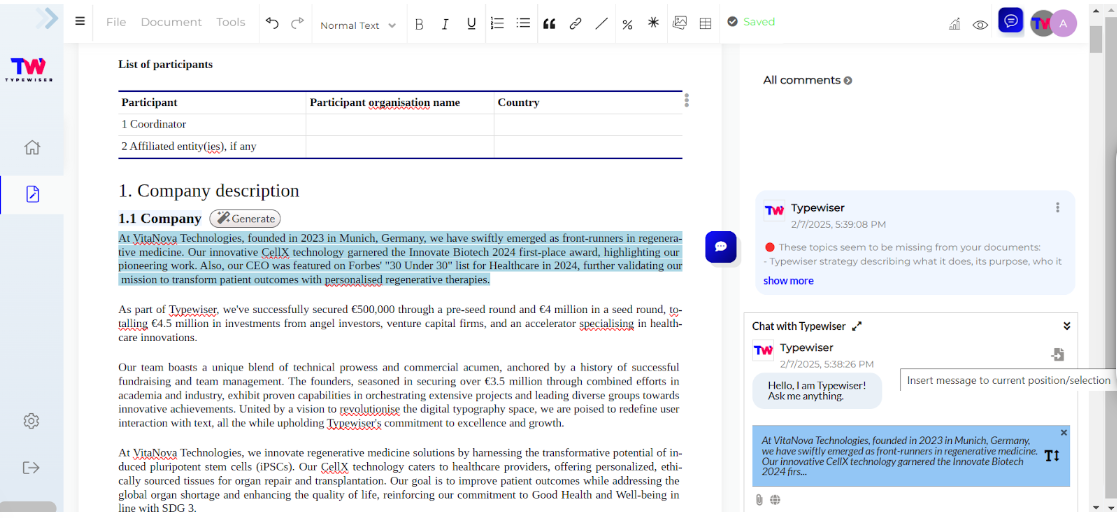
6. Fine-Tuning & Content Optimization

Once a proposal draft is generated, users can fine-tune the content by selecting specific sections for deeper refinement. With AI grant writing capabilities built into every step, Typewiser’s powerful editing tools help enhance clarity, consistency, and tone while keeping the narrative persuasive and professional. Whether you’re polishing a single paragraph or reworking an entire annex, the platform adapts to your needs, making revisions quick and impactful.

Conclusion

Grant writing can be complex and time-consuming, but Typewiser simplifies the process with AI-powered support tailored for startups, SMEs, and consultants. Its real-time evaluation feature integrates expert logic to ensure proposals align with funding goals while maintaining clarity and structure. The AI-driven interview extracts key information through guided questions, eliminating the need for heavy manual input.

With an intelligent chat assistant, users can refine content, retrieve information, and maintain consistency across the proposal. A built-in web search tool provides up-to-date funding insights and reliable sources without leaving the platform. From initial drafting to fine-tuning, Typewiser helps generate high-quality, compliant proposals optimized for funding success.

For startups, SMEs, and consultants looking to streamline their AI grant writing workflow, Typewiser is the ultimate AI-powered solution. Try it today and experience a smarter way to secure funding

Sign up and use it for free today!

Your AI Writing Toolkit: What You Need to Succeed in 2025

Good writing isn’t just about language—it’s about clarity and structure. Documents like grant applications, business proposals, and marketing content need precision. 

AI writing tools streamline drafting, formatting, and optimization, yet many still underuse them. 

To create clear, high-impact documents in 2025, you need the right AI writing tools. 

Here’s a breakdown of the most useful ones and how they can improve your workflow.

Why AI Writing Tools Are Essential

Red background, hand holding a pen and writing on a blank page, AI writing, typewiserAI writing tools simplify content creation by cutting down revisions, improving clarity, and making professional-quality writing easier for anyone to achieve. These tools go beyond automation, empowering professionals to produce high-quality documents without the stress of starting from scratch.

  • Efficiency: Cuts down writing and editing time significantly.
  • Quality: Delivers polished, professional content.
  • Creativity: Offers inspiration and enhances storytelling.
  • Customization: Adapts writing for different formats and audiences.
  • Consistency: Maintains uniformity across multiple documents.

1. Smart Drafting Assistants

Instead of starting from scratch, drafting tools generate structured outlines or even full drafts based on your input. These tools help by providing:

  • Quick first drafts based on minimal input
  • Coherent and structured content across different formats
  • Inspiration when facing writer’s block

How to Use It: Start with a simple prompt or upload key points, and let the tool generate a foundation. Then, refine the draft by adding details, adjusting tone, and personalizing it to match your voice.

2. Advanced Editing and Grammar Checkers

pink background, alphabet tiles, magnifying glass on top of the letters, AI writing, typewiserWriting errors, awkward phrasing, and unclear sentences can weaken your message. AI writing tools that specialize in editing not only check for grammar and spelling but also improve readability and style. These tools help by:

  • Refining sentence structure and clarity
  • Suggesting vocabulary enhancements
  • Ensuring consistent tone and formal correctness

How to Use It: Upload or paste your text and let the tool highlight areas for improvement. Review and apply changes selectively to maintain your unique writing style while ensuring professionalism.

3. Intelligent Research Assistants

Good writing is based on solid research. Some AI writing tools can summarize articles, extract key insights, and even fact-check information for accuracy. These tools help by:

  • Speeding up research time
  • Summarizing large volumes of data
  • Providing citations and references instantly

How to Use It: Input your topic, and let the tool gather relevant insights. Always cross-check critical information to ensure credibility.

4. Summarization and Rewriting Solutions

Need to condense long reports or rewrite content for different audiences? AI writing tools with summarization and paraphrasing capabilities can help distill key messages efficiently. These tools help by:

  • Extracting essential points without losing meaning
  • Rewriting text in a different style or complexity level
  • Adapting content for different audiences and platforms

How to Use It: Paste long text, choose a summary length or rewriting style, and generate a concise, clear version suitable for your needs.

5. Tone and Audience Adaptation Enhancers

Different documents require different tones—formal for proposals, engaging for blogs, and persuasive for pitches. AI writing tools that focus on tone adjustment help ensure your writing matches your audience. These tools help by:

  • Analyzing and adjusting tone to match intent
  • Enhancing engagement based on audience type
  • Maintaining consistency in messaging

How to Use It: Specify the target audience or desired tone, and let the tool suggest revisions to better align with your goals.

6. SEO Optimization and Readability Boosters

Black background, SEO written in a wheel, AI writing, typewiserFor web-based content, visibility is key. AI writing tools designed for SEO ensure your content ranks well while remaining readable. These tools help by:

  • Identifying optimal keywords and readability scores
  • Enhancing content for search engines
  • Improving engagement metrics like time-on-page

How to Use It: Insert your draft, analyze the readability and SEO metrics, and optimize for better online performance.

7. AI Writing Mentor

Effective writing goes beyond simply putting words on a page—it involves structuring ideas logically, reinforcing key arguments, and ensuring every sentence delivers value to the reader. Typewiser works as a mentor, providing suggestions beyond grammar and spelling. They guide you on structuring content, improving clarity, and making arguments more persuasive.

Typewiser is an AI writing guide used for drafting documents. It helps professionals create clear, compelling content that aligns with their goals and their audience.

Privacy, Ethics, and Plagiarism Concerns

While AI writing tools enhance efficiency, they also raise concerns about data privacy, ethical usage, and plagiarism. Users should be cautious about inputting sensitive information, as some tools may store or analyze data. Ethically, AI-generated content should be reviewed to ensure originality and avoid over-reliance on automated suggestions. Plagiarism detection is crucial to maintain credibility, making it essential to fact-check, cite sources properly, and refine AI-generated drafts to reflect authentic, human-driven insights.

The Future of Writing Is Here

AI writing tools simplify content creation, making it easier to produce clear, structured, and professional content. These tools help refine business proposals, strengthen funding applications, and enhance marketing copy, ensuring clarity and precision in every document. 

Writers who integrate AI into their process will work more efficiently and produce higher-quality content, without sacrificing their unique voice. Embracing these tools isn’t about replacing creativity—it’s about enhancing it.


How AI for Writing Ensures Consistency Across Complex Documents

The speed of digital innovation makes consistency more essential than ever.

For companies using generative AI assistants for business,  the need to maintain a uniform tone, vocabulary, and data alignment across extensive documents is crucial to building trust and credibility with clients and users. 

Yet, complex documents often involve multiple authors, evolving datasets, and a myriad of stylistic nuances that can easily become misaligned.

In this article, we explore the challenge of consistency and reveal how AI for writing works under the hood to tackle these issues.

The Consistency Challenge

green background, green opbects kept in a diamond shape, AI text editor, Typewiser, AI writingComplex documents, whether they’re internal reports, white papers, or customer-facing materials, require an unwavering level of consistency in several key areas:

  • Tone and Vocabulary Alignment: Ensuring that every section of a document speaks with the same voice and employs a consistent set of terminology can be challenging—especially when multiple contributors are involved. Inconsistencies not only dilute the message but also harm brand identity.
  • Data and Content Alignment: As documents incorporate evolving data and cross-references, keeping all information accurate and coherent is essential. Discrepancies in figures, outdated references, or misaligned narrative flows can confuse readers.
  • Content Distribution and Structure: Large documents often require carefully structured sections and a unified narrative arc. Inconsistencies in style or formatting can lead to a disjointed reader experience and reduce the overall impact of the content.

Under the Hood: How Generative AI for Writing Maintains Consistency

Generative AI employs advanced techniques to tackle these challenges head on. Here’s how it works:

  1. Natural Language Processing (NLP) and Pattern Recognition

White background, connecting lines ,AI text editor, Typewiser, AI writingAt the heart of generative AI is NLP, which allows the system to understand and generate human-like language. By analyzing vast datasets, the AI for writing identifies patterns in tone, word choice, and sentence structure. These patterns become the “rules” that guide content creation—ensuring that every generated sentence aligns with the desired style and vocabulary.

  1. Style Guides and Custom Training

To maintain a consistent voice, companies often feed the AI with detailed style guides and brand guidelines. These documents serve as a blueprint, instructing the AI on preferred phrasing, terminology, and formatting. Over time, through techniques like fine-tuning and reinforcement learning, the AI adapts to mimic the established voice across all outputs.

  1. Iterative Feedback and Real-Time Editing

Generative AI tools integrate feedback loops where human editors can fine-tune and adjust the generated content. This iterative process not only improves immediate drafts but also refines the AI’s future outputs. With features such as automatic grammar checking, tone adjustment, and consistency verification, AI for writing becomes a reliable partner in maintaining uniformity across lengthy and complex documents.

  1. Data Integration and Consistency Checks

For documents that rely on data, AI tools can automatically cross-check figures and references against current databases. This automated verification minimizes errors and ensures that all sections of a document are aligned with the latest information. AI-driven content management systems also help distribute and structure content uniformly throughout the document.

Real-World Use Case Scenarios

document, man touching document, AI text editor, Typewiser, AI writing

To better understand the impact of these techniques, consider the following examples:

  • Corporate Reports: Large multinational corporations generate annual reports that include contributions from multiple departments. An AI writing assistant ensures that the final document maintains a consistent tone and accurately reflects company terminology, regardless of the varied inputs.
  • Technical Documentation: For software companies, product manuals and API documentation must be clear, accurate, and stylistically uniform. Generative AI tools analyze previous versions of documents to produce updates that match the existing style and data, significantly reducing manual editing time. AI for writing ensures consistency while streamlining the documentation process..
  • Marketing Content: Agencies producing long-form content and white papers benefit from AI’s ability to integrate style guides. By automatically adjusting the tone and vocabulary to match brand guidelines, the AI helps produce polished, consistent material that resonates with the target audience.

Conclusion

Consistency in complex documents is a multifaceted challenge—one that is critical to ensuring clarity, credibility, and brand integrity. Generative AI tackles this challenge with its powerful blend of NLP, custom training on style guides, iterative feedback loops, and robust data integration. 

By automating the enforcement of tone, vocabulary, and data alignment, AI tools streamline the content creation process and at the same time empower writers and organizations to focus on what matters most: delivering clear, cohesive, and compelling narratives.

Typewiser acts as an AI writing mentor, guiding users to craft high-performance documents with precision and ease. Sign up for Typewiser today and experience the power of AI-powered writing!